I wanted to add a coda to my On Unsolid Ground series. Coda because I promised the last segment was the one before this—but need to add one more thought to the series.
I haven’t read much of this writer, but am hoping to get a hold of more of his books. He has a lot. He seems to make art out of everything in his life: essays, memoir in novels, poetry, etc. with very little provocation—at least that’s how it appears. Again, I need to read more.
He is a writer straddling both America and India, memories inform much of his writing. So, I guess he lives also in the present and the past.
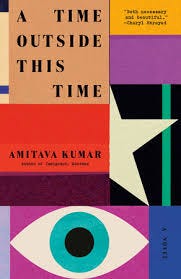
I feel as if he is working out thorny issues from his childhood, random memories in his writing. Now, I have no idea of what is true or not true. A Time Outside This Time is categorized as fiction. It starts with the main character (Kumar?) at an artist residency where he is questioned at the opening cocktail party about what it is he is planning to do. He’s not sure. There is news from the outside of a pandemic spreading across the globe. This becomes a distraction for everyone at the residency, some artists leave early. (Kumar?) doesn’t know what to do. –Is this fiction or a journal entry?!— He remembers confusing moments from his past, civil wars, classism; he doesn’t know how to think about them. He reserves judgment. The “novel” is a hall of mirrors, a collection of related stories about things that could have happened. It’s hard to distinguish the truth.
He’s writing about living through the first Trump presidency.
Need I say more? No.
What we read in the news and on social media is to be taken with a grain of salt. What does this even mean? Kumar is interested in how we locate truth in a world of fake news. In a world of hyperbole, self-aggrandizement, exaggeration, propaganda—where nothing means what it used to mean or what we thought it meant.
I recommend reading A Time Outside This Time for its handling of then current events, how to integrate what’s happening in and around you and processing reality through memory(ies). It might be considered meta fiction, autofiction—not sure. But I believe the question might be answered in reading more of his work.
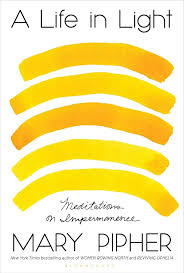
In addition, I also want to recommend Mary Pipher’s A Life in Light. Mary Pipher is the much-acclaimed author of Reviving Ophelia—now over 30 years ago! I once had the privilege of introducing Mary at a book reading in Chicago at Women & Children First bookstore. I did a terrible job. Anyway, this is her latest book. She’s getting up in years, as am I, and I liked how she organized this “memoir,” which also includes the oncoming pandemic, separation from family, and a sense of loss. The book is a collection of essays loosely organized under sections. One gets a sense that they may have been journal entries that she revisited and expanded upon in order to give the book an arc.
Again, this is a way of looking at memoir, not from a chronological perspective, but something like a visit, where one sits for a spell, tells a story, and then, when the coffee is done, drained from the cup, gets up and leaves—until the next time. I like this idea of slow memoir. Like much in the “slow” movement, one doesn’t have to tell it all or experience everything or hit all the highlights. One is allowed to slow down and unravel a memory and see how it fits with the collective whole.
If you’re interested in approaching memoir from a less rigid form—both books may be of interest.